
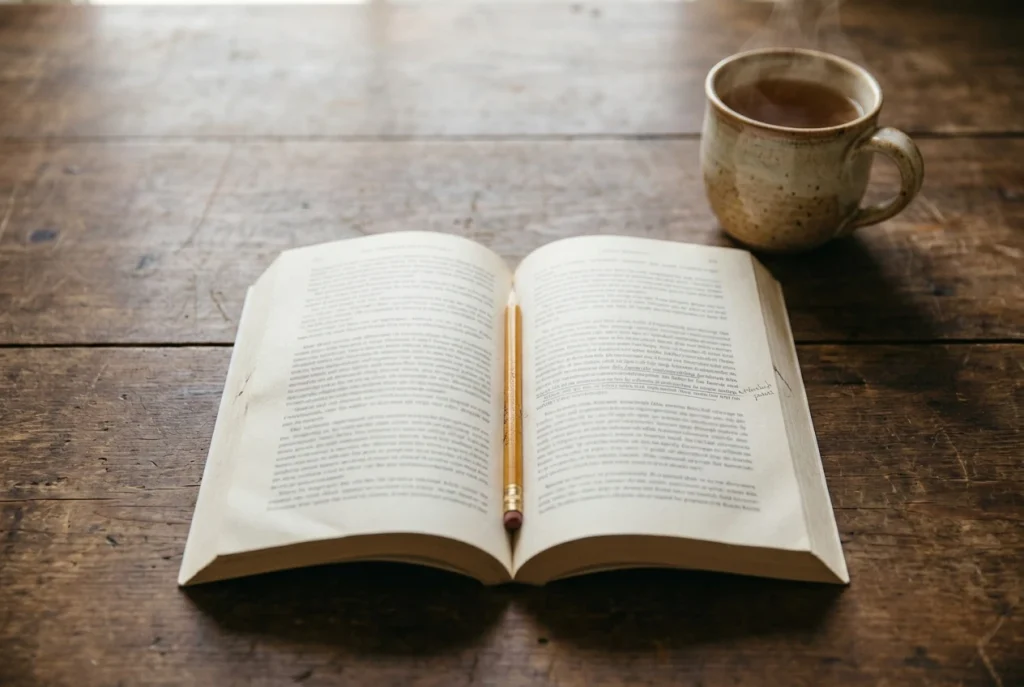
A book can help you in a way most other media cannot, because it asks for sustained attention to one person’s thinking for hours or days. That alone changes how you work with ideas. What the book contains changes you further, and the range of what books contain is wide enough that nearly every situation has a title written for it.
This article covers how different kinds of books help, how to choose one for the problem in front of you, and how to read so that something carries over into your life. The reading reactions, curiosity lists and reviews on this site all come from the same belief: picking up a book is rarely a wasted decision.
What reading does even before you reach the useful part
Reading a book of any length means following an argument or a story across many pages. You hold earlier details in mind while new ones arrive. You notice when a claim contradicts something said fifty pages ago. This is a skill, and it gets stronger with use.
Books also slow you down. A short video or a feed delivers conclusions in seconds, while a book lays out the reasoning, the evidence and the exceptions. When you read a long explanation, you can pause, reread a paragraph and disagree with it in the margin. That makes it easier to tell a sound idea from one that only sounds confident.
There is also the plain matter of vocabulary and expression. Readers meet words and sentence structures they would not use in daily conversation, and over time those become available when they need to explain something or write an email that has to be clear.
Different kinds of books help in different ways
The phrase “a book can always help you” holds up because books do different jobs. It is worth naming a few.
Books that teach a method
Self-development and habit books give you a framework you can apply the same week. The review of Atomic Habits on this site looks at a book built around the idea that small, repeatable changes add up. Books like this work best when you pick one idea and try it, rather than trying to adopt every suggestion at once.
Books that explain how you work
Some books explain the mind and the body behind your behavior. Loretta Breuning’s Habits of a Happy Brain is about the brain chemicals linked to motivation and mood, and the review titled Can We Choose To Be Happy? takes up the question in its title. A book like this will not solve a problem for you, but understanding why a feeling arises makes it easier to respond to it on purpose.
Books that show a life lived
Memoirs and biographies give you a person’s decisions with the context around them. The post on a memoir by Imelda Lahoz Argel is about a life the review describes as inspiring and courageous. Reading someone else’s hard stretch does not remove your own, yet it widens your sense of what people get through and what they do next.

Books that put you somewhere else
Fiction, short stories and travel writing take you into places and minds you will not visit otherwise. Pieces here such as Beautiful North East India Sketched In A Travelogue and Ruskin Bond’s stories belong in this group. They build attention to detail and a habit of imagining how other people live, which is useful in conversation, in work and in family life.
Choosing a book for the problem you have
A book helps most when it matches the question you are asking. Before you open a shelf or a bookstore page, write one sentence about what you want. It can be practical (“I want to stop putting off my morning routine”), emotional (“I want to feel less restless”), or open (“I want something absorbing for the weekend”).
Then match the sentence to a type:
- A practical goal points to a method book, ideally one that is short enough to finish and apply.
- A feeling you want to understand points to a book on psychology or a thoughtful memoir.
- A wish to rest your mind points to fiction or travel writing you would enjoy for its own sake.
- A wish to widen your view points to authors from places and backgrounds you rarely read.
If you feel stuck, there is a specific list for it: 10 Books to Read When You Feel Stuck collects titles that are on my to-read list for that situation. Since they are to-read titles, treat the list as a set of promising starting points and not as endorsements of finished reads.
How to read so that the book changes something
Finishing a book and being changed by it are separate outcomes. A few habits close the gap.
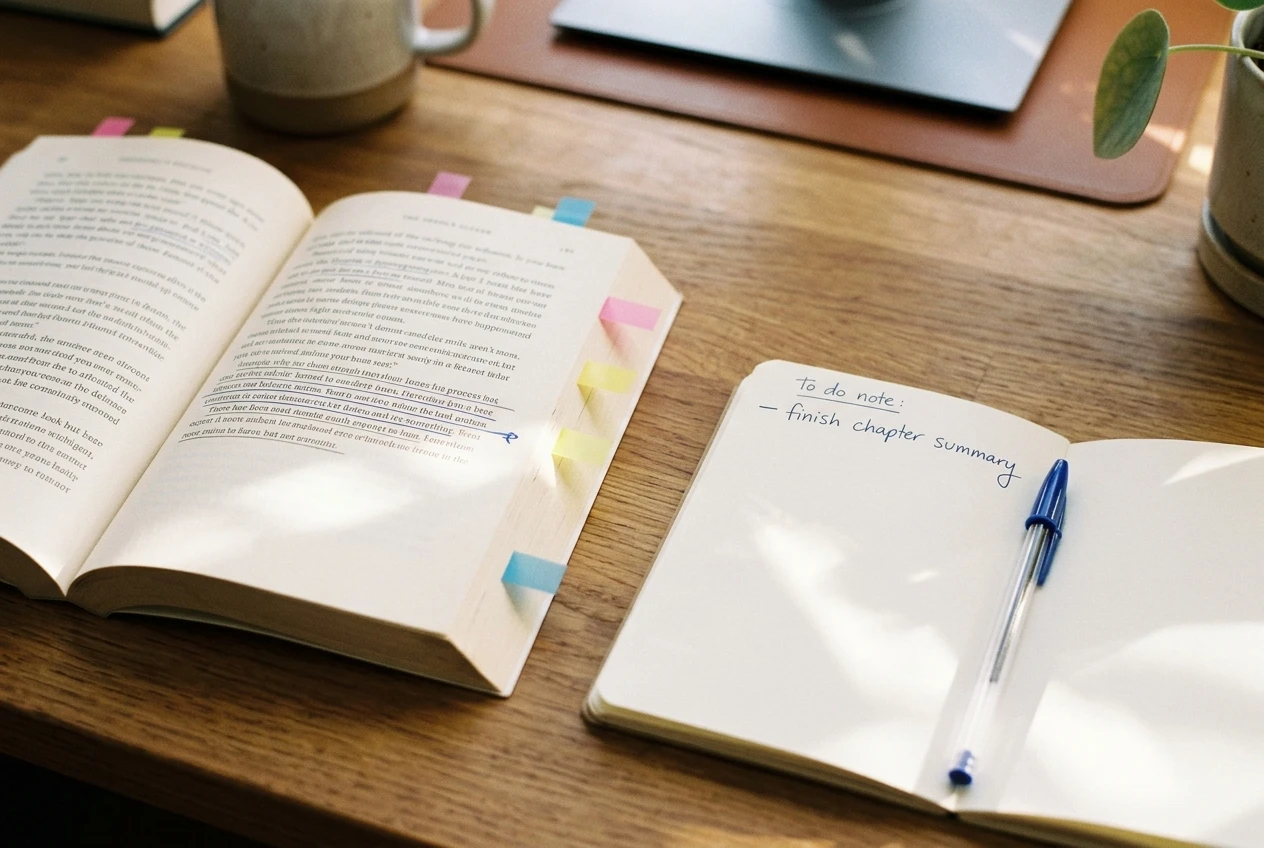
- Read with a question. The sentence you wrote before choosing the book works as a filter. When a passage answers it, mark the passage.
- Write down one action. After each reading session, note a single thing you could do differently. Keep it small enough to finish within a day.
- Reread your marks. Skim your underlined passages a week after finishing. What still seems important then is usually what matters.
- Say it to someone. Explaining a chapter to a friend shows you which parts you actually understood and which parts you only recognized.
- Allow disagreement. A book that argues against what you believe is useful if you can state its case fairly before rejecting it.
Fiction works through different habits. There you may simply notice which character you sympathized with, which one irritated you and why. Those reactions say something about your own values, and writing them down is how a book review begins.
When a book does not help
Some books will not work for you, and that is part of the process. A method book may suit someone with a different schedule. A famous novel may read as slow if you are tired. Stopping a book is a reasonable decision, particularly when you can name why it is not working: the style, the pace, the subject, or the timing.
The useful response is to adjust, not to give up reading. Try a shorter book, a different genre, or the same topic by a different author. Reading preferences move around over the years, and a title that bounced off you in one season sometimes reads well in another.

This is also why honest reactions are worth recording. A review that says what a reader expected, what the book delivered and who might enjoy it more is useful to the next person choosing. That is the kind of writing this site aims for in its reading reactions, and it is why the posts about covers and titles that made me curious are kept apart from reviews of books already read. A curiosity is an honest starting point too, as long as it is labeled as one.
Making reading a regular part of the week
The size of the habit matters less than its regularity. Ten pages a day is about a short book each month for most readers, and it fits into a commute, a lunch break or the time before sleep. Leaving the book somewhere visible, such as the table beside your bed, makes it more likely you will open it.
Some practical choices make a difference:
- Keep one book going at a time while you are building the habit, then add a second in a different genre once the first routine holds.
- Use a library or a second-hand shelf for the books you are unsure about, so a poor choice costs little.
- Read in the format you will actually use. Print, e-reader and audio each suit different situations, and the best format is the one you open.
- Track what you read in a simple list with a line or two about your reaction. After a few months the list shows your tastes more clearly than memory does.
A book does not need to be famous or difficult to be worth your time. It needs to be a good match for the question you bring to it, and to be read with enough attention that something stays. Choose a title from the lists on this site or from your own shelf, give it a few days of ten pages each, and see what you would do differently afterward. If the answer is anything at all, the book has already helped.